Tuesday, 25 November 2014
HISTORY OF THANKSGIVING primarygames.com
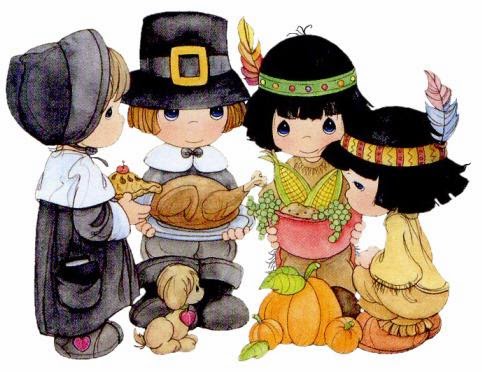
Pilgrims sailed to America from Holland to escape
religious persecution. In the hope of a better life, they took the help of a
London stock company to move out to America and set sail aboard a ship called
the Mayflower.
They reached Plymouth in 1620. There, they had to face a terrible winter. Around 46 of the original 102 had died by the next fall. But fortune turned in their favor and the harvest of the next year was plentiful. The remaining colonists decided to celebrate with a feast, including 91 Indians who had helped the Pilgrims survive their first year. It is believed that the Pilgrims would not have made it through the year without the help of the natives. The feast was more of a traditional English harvest festival than a true "thanksgiving" observance. It lasted for three days. Governor William Bradford sent "four men fowling" after wild ducks and geese. It is not certain that wild turkey was part of their feast. However, it is certain that they had venison. The term "turkey" was used by the Pilgrims to mean any sort of wild fowl.
On
June 20, 1676, the governing council of Charlestown, Massachusetts, held a
meeting to determine how best to express thanks for the good fortune that had
seen their community securely established. By unanimous vote they instructed
Edward Rawson, the clerk, to proclaim June 29 as a day of thanksgiving. It is
notable that this thanksgiving celebration probably did not include the
Indians, as the celebration was meant partly to be in recognition of the
colonists' recent victory over the "heathen natives". October of 1777
marked the first time that all 13 colonies joined in a thanksgiving
celebration. It also commemorated the patriotic victory over the British at
Saratoga. But it was a one-time affair.
George Washington proclaimed a National Day of
Thanksgiving in 1789, although some were opposed to it. There was discord among
the colonies, many feeling the hardships of a few Pilgrims did not warrant a
national holiday.
Later, President Thomas Jefferson scoffed at the idea of having a day of thanksgiving. It was Sarah Josepha Hale, a magazine editor, whose efforts eventually led to what we recognize as Thanksgiving. Hale wrote many editorials championing her cause in her Boston Ladies' Magazine, and later, in Godey's Lady's Book.
Finally, after a 40-year campaign of writing editorials and letters to governors and presidents, Hale's obsession became a reality when, in 1863, President Lincoln proclaimed the last Thursday in November as a national day of Thanksgiving.
Thanksgiving was proclaimed by every president after Lincoln. The date was changed a couple of times, most recently by Franklin Roosevelt, who set it up one week to the next-to-last Thursday in order to create a longer Christmas shopping season. Public uproar against this decision caused the president to move Thanksgiving back to its original date two years later.
In 1941, Thanksgiving was finally sanctioned by Congress as a legal holiday on the fourth Thursday in November.
Later, President Thomas Jefferson scoffed at the idea of having a day of thanksgiving. It was Sarah Josepha Hale, a magazine editor, whose efforts eventually led to what we recognize as Thanksgiving. Hale wrote many editorials championing her cause in her Boston Ladies' Magazine, and later, in Godey's Lady's Book.
Finally, after a 40-year campaign of writing editorials and letters to governors and presidents, Hale's obsession became a reality when, in 1863, President Lincoln proclaimed the last Thursday in November as a national day of Thanksgiving.
Thanksgiving was proclaimed by every president after Lincoln. The date was changed a couple of times, most recently by Franklin Roosevelt, who set it up one week to the next-to-last Thursday in order to create a longer Christmas shopping season. Public uproar against this decision caused the president to move Thanksgiving back to its original date two years later.
In 1941, Thanksgiving was finally sanctioned by Congress as a legal holiday on the fourth Thursday in November.
Sunday, 23 November 2014
LONDON EYE Project Britain. British Life and Culture by Mandy Barrow
The world's highest observation
wheel (a type of Ferris wheel).
The British Airways
London Eye (Millennium Wheel) stands 135 metres (443 feet) high on the South
Bank of the River Thames between Westminster and Hungerford Bridges. It is the
world's highest observation wheel.
The wheel was
constructed in sections which were floated up the river Thames on barges and
assembled lying flat on pontoons. Once the wheel was complete it was raised
into its upright position by cranes, initially being lifted at a rate of about
2 degrees per hour until it reached 65 degrees.
The total weight of
steel in the Eye is 1,700 tonnes.
BRITISH NATIONAL ANTHEM Project Britain. British Life and Culture by Mandy Barrow
The National Anthem is God Save the Queen. The British
National Anthem originated in a patriotic song first performed in 1745. It
became known as the National Anthem from the beginning of the nineteenth
century.
On official occasions the first verse is sung, as
follows:
God save our gracious Queen!
Long live our noble Queen!
God save the Queen!
Send her victorious,
Happy and glorious,
Long to reign over us,
God save the Queen.
Long live our noble Queen!
God save the Queen!
Send her victorious,
Happy and glorious,
Long to reign over us,
God save the Queen.
The second verse is occasionally sung as well:
Thy choicest gifts in store
On her be pleased to pour,
Long may she reign.
May she defend our laws,
And give us ever cause,
To sing with heart and voice,
God save the Queen.
On her be pleased to pour,
Long may she reign.
May she defend our laws,
And give us ever cause,
To sing with heart and voice,
God save the Queen.
When is the British National Anthem sung?
The National Anthem is played whenever The Queen makes
a public appearance and is played by the British Broadcasting Corporation every
night before closedown.
It is also
sung:
- At
the end of all Remembrance Day services.
- Medal
ceremonies for Team GB (representing all countries).
- England
and Northern Ireland football matches (the Scottish use Flower of
Scotland, the Welsh use Land of my Fathers - Hen Wlad Fy Nhadau.
Tuesday, 11 November 2014
Monday, 10 November 2014
Subscribe to:
Posts
(
Atom
)